
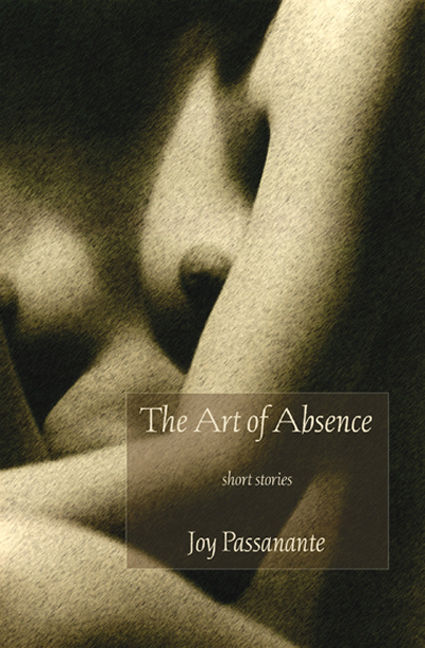
THE ART OF ABSENCE
ISBN: 978-0-9717265-4-3
Pub Date: Fall 2004
Pages: 186
By Joy Passanante
Like Passanante's other work, the stories in this volume are moving because of their humanity and the beauty of the writing. I felt that each story was a visit to a different room in the house of the soul (though there are doors between the rooms and influences move from one to another). Passanante's writing is sensuous, in its concreteness, its imagery, and the descriptions of sensation and feeling. It is also precise—I never found an unnecessary or a not-quite-right word. The characters are sexual, and Passanate's writing is wonderfully honest about the complexity of sexual feeling and expression. Sexuality is also their medium of expression, and the complexity of experience is reflected in the complexity of the characters' sexual feeling and behavior. There is much wit, and there is also tragedy. This is one of those writers who, even in her more gothic moments, describes a human being in a way that makes you recognize, sometimes reluctantly, some secret in yourself.
There's wit, variety, and imaginative boldness in this collection of stories, as well as a pleasurable richness of detail that captures different social, geographical, and natural environments with precision and grace. That attunement to place—whether the nursery downstairs from the Middle America bowling lanes or the TriBeCa restaurant with its trendy menu-of-the-minute—conveys not only the world these characters inhabit, but their consuming, poignant hunger. Though the overt subject of most of these stories is passion that transgresses the boundaries of marriage and of other familial and professional codes, what the characters act out in surprising, creative, and sometimes terrifying ways are the hopes and unforeseen consequences of the post-war suburban dream of the perfect place, the home that will satisfy every need and settle all questions. Children of the migrations that brought their grandparents from Europe and their parents from the city, Passanante's characters, planted in an Eden meant to end desire, find themselves dreaming of other places, of cities, of the East (whether Boston or India), of transient apartments and hotels—and of other houses, houses that, no matter how familiar their mass-produced design, might just become, contain, or conceal some unknown and absolutely necessary secret ungraspable at home—perhaps that life unlived while the dreamers passed their own youth in striving to act out their parents' dreams. . .
Passanante's deft touch gives rise to a short story collection that is as provocative as endearing. These stories of love and betrayal examine the ways we burn with passion and, on occasion, find it necessary to rise from the ashes. This is a writer of great wit and wisdom, one who makes us laugh in spite of ourselves.
—Claire Davis, author of Winter Range and Season of the Snake
